Your shoulders feel hard. Your neck is constantly tight. Your back never seems completely relaxed.
You stretch. Move around. Maybe take a hot shower.
It feels better for a while.
Then the tightness returns.
If this sounds familiar, you may have wondered whether Deep Tissue Massage could help—and what actually happens to those tight muscles when a massage therapist starts working on them.
Deep Tissue Massage isn’t simply about pressing harder.
A professional Deep Tissue Massage in Vienna should involve controlled, targeted work adapted to your body, your comfort and the muscular areas that need attention.
Here’s what that means.
Why Do Muscles Feel Tight in the First Place?
Muscular tightness can develop for many reasons.
For office workers, long periods at a computer can leave the neck, shoulders and back feeling tense.
For active people, repeated training can leave heavily used muscle groups feeling tired and tight.
And during stressful periods, some people unconsciously tense their shoulders, neck or jaw throughout the day.
Your daily habits matter too.
Sitting. Commuting. Training. Smartphone use. Repetitive movements. Insufficient recovery.
When these patterns repeat week after week, muscular tension can start feeling normal—even when your body is asking for recovery.
What Is Deep Tissue Massage?
Deep Tissue Massage is a more focused massage approach used to work on areas of muscular tension.
But there’s an important misconception:
Deep tissue does not automatically mean maximum pressure.
The objective isn’t to tolerate as much force as possible.
Pressure should be controlled and adjusted according to the area being treated, your individual needs and your comfort.
At Luxury Massage, communication matters. If the pressure feels too intense—or too light—you should tell your therapist.
A professional treatment should feel purposeful, not like an endurance test.
What Happens When the Therapist Finds a Tight Area?
Imagine you’ve spent the entire week working at a computer.
By Friday, your shoulders feel heavy and the muscles around your upper back feel tight.
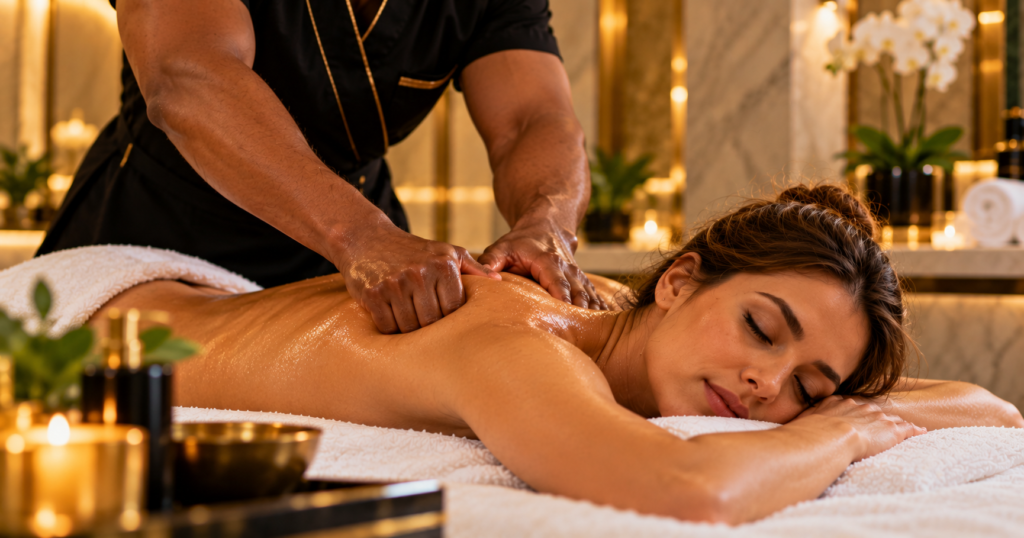
During a Deep Tissue Massage, the therapist can spend more time working through those areas rather than treating every part of the body identically.
Movements may become slower and more focused.
Pressure can be progressively adapted.
The therapist may work across the surrounding muscular area rather than repeatedly pressing one uncomfortable point.
The goal is targeted hands-on work on the areas where you experience muscular tension.
Why Slow, Controlled Pressure Matters
More force isn’t necessarily better.
Deep Tissue Massage often benefits from controlled work rather than aggressive pressure.
If someone immediately applies excessive force to an already sensitive area, your natural response may be to tense up rather than relax.
That’s the opposite of what you want.
A structured treatment gives your body time to respond while allowing the therapist to adjust technique and pressure.
That’s also why communication between client and therapist is essential throughout the session.
Deep Tissue Massage for Neck and Shoulder Tension
The neck and shoulders are common problem areas for professionals and office workers.
Hours spent typing, looking at screens and using smartphones can contribute to muscular tightness around the upper body.
Add workplace stress and you may find yourself repeatedly:
- Rolling your shoulders
- Stretching your neck
- Rubbing your upper back
- Changing sitting positions
- Feeling stiff after work
For these clients, Deep Tissue Massage can be adapted to give additional attention to the shoulders, upper back and surrounding muscular areas.
If your problem is highly localized, a dedicated Shoulder & Neck Massage or Shoulder-Back-Neck Massage may also be worth considering.
Deep Tissue Massage for Active People
You don’t need a desk job to develop tight muscles.
Running, cycling, strength training and other forms of exercise repeatedly load specific muscle groups.
Training creates demand.
Recovery needs to follow.
If your muscles consistently feel tight or heavily worked between training sessions, professional massage can complement your wider recovery routine alongside appropriate rest, movement, hydration and nutrition.
Depending on your goals, either Deep Tissue Massage or Sports Massage may be suitable.
Should Deep Tissue Massage Hurt?
This is one of the biggest misconceptions about the treatment.
Some clients assume:
“If it doesn’t hurt, it isn’t working.”
That isn’t a useful standard.
Deep Tissue Massage can feel intense in certain areas, particularly where you already feel muscular tension, but intensity should not be confused with uncontrolled pain.
Pressure should remain appropriate for you.
If something feels excessively painful, sharp, unusual or simply wrong, communicate immediately with your therapist.
Professional massage is not a competition to see how much discomfort you can tolerate.
What Might You Feel After a Deep Tissue Massage?
Everyone responds differently.
Some clients feel deeply relaxed immediately after treatment. Others may become more aware of areas that were particularly tight or heavily worked.
This is one reason your first Deep Tissue session should not be approached with the mentality that “harder is always better.”
The treatment should be adapted to you.
After your massage, follow any appropriate guidance from your therapist and pay attention to how your body feels.
Is Deep Tissue Massage Right for You?
Deep Tissue Massage may appeal to you if you:
- Regularly experience muscular tightness
- Spend long hours sitting at a desk
- Feel tension around your shoulders or upper back
- Train or exercise frequently
- Prefer focused massage work
- Want more targeted attention than a purely relaxation-focused treatment
- Find yourself repeatedly stretching the same tight areas
But Deep Tissue Massage isn’t automatically the right choice for every client.
Sometimes a Classic Massage, Sports Massage, targeted Neck & Shoulder Massage or Relaxation Massage may better match what you’re looking for.
The right treatment depends on your goals, preferences and individual circumstances.
Deep Tissue Massage in Vienna at Luxury Massage
If you’re searching for a professional Deep Tissue Massage in Vienna, Luxury Massage offers individually tailored treatments in a calm, premium environment in Neubau, 1070 Wien.
Rather than treating Deep Tissue Massage as simply “hard massage,” the treatment focuses on structured, targeted work according to where you experience muscular tension and how much pressure is appropriate for you.
Luxury Massage also offers complementary treatments including Sports Massage, Classic Massage, Full-Body Massage, Back Massage, Shoulder & Neck Massage, Shoulder-Back-Neck Massage, Anti-Stress Massage and Relaxation Massage.
Don’t Wait Until Tightness Becomes Your New Normal
One of the easiest things to do with muscular tension is adapt to it.
You get used to the stiff shoulders.
You get used to stretching your neck every afternoon.
You get used to your back feeling tight after work.
Eventually, you stop asking why your body feels that way.
But recurring muscular tension is worth paying attention to.
Movement, exercise, ergonomics, rest and recovery all matter—and professional massage can form part of that broader strategy.
Your body works for you every day. Give it dedicated time to recover.
Not sure which treatment best fits your needs? Read our guide to full-body massage vs deep tissue massage to compare the two options before booking.
Book Your Deep Tissue Massage in Vienna
Looking for a professional Deep Tissue Massage in Vienna?
Visit Luxury Massage, Kirchberggasse 35/1, 1070 Wien (Neubau) for a treatment tailored to your individual needs and preferred pressure.
Book your Deep Tissue Massage at LuxuryMassage.at and give tight, overworked muscles the attention they deserve.
Massage is a wellness treatment and is not a substitute for medical diagnosis or treatment. Persistent, severe, unexplained, injury-related or neurological symptoms should be assessed by an appropriate healthcare professional.