
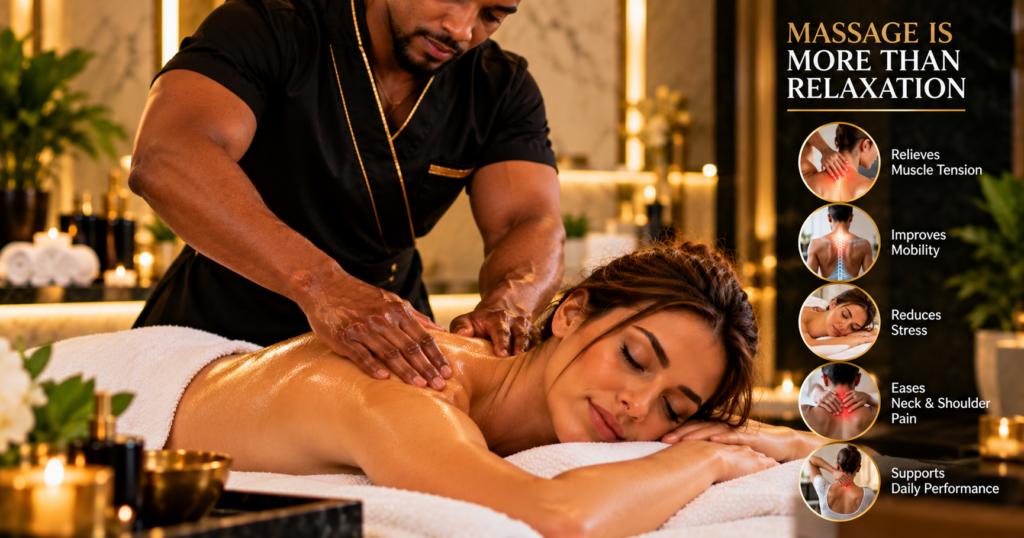
Mention massage and many people immediately picture the same thing:
Candles. Soft music. A spa day. Maybe a hotel somewhere on holiday.
Relaxation is certainly one reason people book massage.
But reducing professional massage to “something you do when you want to relax” misses a much bigger picture.
For office workers with tight shoulders, active people dealing with heavily worked muscles, professionals carrying tension after demanding weeks and clients who simply want structured recovery, different massage treatments can serve very different purposes.
So let’s clear up some of the most common misconceptions.
Myth #1: Massage Is Only for Relaxation
This is probably the biggest misconception.
Some massage treatments are specifically designed around relaxation. Relaxation Massage and Anti-Stress Massage, for example, may appeal to clients whose primary goal is to slow down and disconnect from a demanding routine.
But that’s only part of the massage spectrum.
A client with muscular tightness may prefer Deep Tissue Massage.
Someone whose working day leaves their neck and shoulders feeling tense may choose a Shoulder & Neck Massage.
An active client may consider Sports Massage.
Someone experiencing more general tension may prefer a Full-Body Massage.
The important question isn’t:
“Do I want a massage?”
It’s:
“What do I want from my massage?”
Myth #2: Every Massage Is Basically the Same
They’re not.
If every massage consisted of exactly the same movements, pressure and treatment sequence, there would be little reason to offer different treatments.
Your goals matter.
Your preferred pressure matters.
Where you feel muscular tension matters.
Whether you want focused muscular work or primarily relaxation matters.
That’s why professional massage should begin with communication.
Before treatment, tell your therapist what you’re experiencing and what you want from the session.
A massage for someone with tight shoulders after a week at a computer shouldn’t necessarily feel identical to a relaxation-focused treatment for someone who simply wants to slow down.
Professional massage should have a purpose.
Myth #3: Harder Pressure Means a Better Massage
This misconception is especially common with Deep Tissue Massage.
Some people arrive believing the therapist needs to use as much pressure as possible for the treatment to be effective.
That’s not a useful standard.
Deep Tissue Massage can involve firmer, more focused work, but pressure should still be adapted to the client, the treatment area and individual comfort.
A professional therapist should not treat massage as a competition to see how much discomfort you can tolerate.
If pressure feels excessive, communicate.
If you prefer more pressure, communicate that too.
The right pressure is not necessarily the maximum pressure.
Myth #4: You Should Wait Until Something Hurts Before Booking
Many people treat massage reactively.
Their shoulders become extremely tight.
Their neck feels stiff.
Their back has been uncomfortable all week.
Then massage becomes a priority.
But recovery doesn’t necessarily need to begin only after your body is demanding attention.
Think about how you approach other aspects of wellbeing.
You don’t exercise only when you feel physically unfit.
You don’t sleep only after becoming completely exhausted.
You don’t take holidays only after you’ve forgotten what a weekend feels like.
Massage can also be incorporated proactively into a broader recovery and wellness routine.
Myth #5: Massage Is Only for People With Physical Jobs
A desk job may not look physically demanding.
Your body may disagree.
Hours spent at a computer can mean long periods in relatively static positions.
Your hands stay near the keyboard.
Your shoulders may gradually round.
Your head moves toward the screen.
Your neck remains in similar positions for extended periods.
Then there’s workplace stress.
By late afternoon, you may find yourself rubbing your shoulders, stretching your neck or shifting repeatedly in your chair.
Office workers and professionals can therefore have very practical reasons for booking massage—even if they haven’t lifted anything heavier than a laptop all day.
Myth #6: Stretching Is Always Enough for Tight Muscles
Movement and stretching can be useful parts of a healthy routine.
But many people recognize this cycle:
Stretch.
Temporary relief.
Return to the desk.
Tension returns.
Stretch again.
If you’re constantly stretching the same neck, shoulder or back area, consider the broader pattern.
How long are you sitting?
How often are you moving?
How is your workstation arranged?
Are you recovering adequately from exercise?
Are stressful periods accompanied by physical tension?
Professional massage can complement—not replace—good movement, exercise, sleep, ergonomics and appropriate healthcare.
Myth #7: Massage Is an Indulgence You Need to Earn
This idea is particularly common among busy professionals.
Massage becomes a reward.
Finish the project.
Survive the deadline.
Get through the difficult month.
Then maybe book a massage.
But recovery doesn’t have to be a prize for exhaustion.
For some people, massage simply becomes one part of how they allocate time to their wellbeing.
You schedule the gym.
You schedule the dentist.
You schedule important meetings.
You can schedule recovery too.
You don’t need to reach exhaustion before giving your body attention.
So What Makes a Massage Professional?
A premium environment is valuable, but professionalism goes beyond the room.
A professional massage experience should involve:
- Clear communication before treatment
- Understanding your goals and preferences
- Appropriate draping and respect for privacy
- Good hygiene
- Pressure adapted to your comfort
- A treatment selected for your needs
- Clear professional boundaries
- A calm, structured environment
The treatment should feel intentional rather than generic.
That distinction matters when you’re choosing where to spend your time—and who you trust with your massage.
Which Type of Massage Should You Choose?
Start with your primary goal.
“I want to relax and switch off.”
Consider Relaxation Massage or Anti-Stress Massage.
“My neck and shoulders always feel tight.”
A Shoulder & Neck Massage may provide more targeted attention.
If the tension extends farther down the back, consider Shoulder-Back-Neck Massage.
“I prefer focused work on tight muscles.”
Consider Deep Tissue Massage, depending on your preferences and individual circumstances.
“I train regularly.”
Sports Massage may fit better within an active recovery routine.
“I feel tense everywhere.”
A Full-Body Massage provides a broader treatment experience.
The objective isn’t to choose the massage with the most impressive name.
Choose the treatment that best matches what you want from the session.
Professional Massage in Vienna at Luxury Massage
If you’re looking for a professional massage in Vienna, Luxury Massage provides individually tailored treatments in a calm, premium setting in Neubau, 1070 Wien.
The studio is designed for professionals, entrepreneurs, expats, active people and quality-conscious clients who value privacy, comfort and professional service.
Available treatments include Deep Tissue Massage, Classic Massage, Sports Massage, Full-Body Massage, Relaxation Massage, Anti-Stress Massage, Back Massage, Shoulder & Neck Massage, Shoulder-Back-Neck Massage, Partial-Body Massage, Foot Massage and Lymphatic Drainage Massage.
Instead of assuming every client needs the same thing, your treatment can be selected according to your individual goals and preferences.
Massage Can Be Relaxing—Without Being “Just Relaxation”
Yes, massage can help you slow down.
Yes, it can be an enjoyable part of your week.
And yes, a premium environment can make the experience feel special.
But professional massage doesn’t have to be reduced to candles and spa days.
It can also mean targeted attention for overworked muscles.
Structured recovery after demanding weeks.
Dedicated time away from your desk.
Or simply becoming more intentional about taking care of your body.
The question isn’t whether massage is “relaxation” or “recovery.”
It can be both—the important thing is choosing the right treatment for what you need.
Book Your Professional Massage in Vienna
Not sure which massage is right for you?
Visit Luxury Massage, Kirchberggasse 35/1, 1070 Wien (Neubau) and choose a treatment based on your individual needs, areas of tension and preferred massage style.
Book your professional massage at LuxuryMassage.at and experience massage designed around you—not a generic routine.
Massage is a wellness treatment and is not a substitute for medical diagnosis or treatment. Persistent or severe pain, numbness, weakness, unexplained symptoms, injury-related problems or other concerning symptoms should be assessed by an appropriate healthcare professional.
